

Martin Luther King Jr. is one of the most influential figures in American history, remembered for his leadership during the Civil Rights Movement and his unwavering commitment to justice, equality, and nonviolent change. His work reshaped the nation’s laws, conscience, and understanding of civil rights, making his legacy worthy of national recognition through Martin Luther King Jr. Day.
Born on January 15, 1929, in Atlanta, Georgia, King grew up in a deeply segregated society that shaped his early awareness of racial injustice. Influenced by his faith as a Baptist minister and inspired by Mahatma Gandhi’s philosophy of nonviolent resistance, King emerged as a powerful voice for peaceful protest. He first gained national attention in 1955 as a leader of the Montgomery Bus Boycott, a year-long protest sparked by Rosa Parks’ arrest, which ultimately led to the desegregation of public buses.
Throughout the late 1950s and 1960s, King became the central figure of a movement that challenged discriminatory laws and practices across the United States. He helped found the Southern Christian Leadership Conference (SCLC), organizing marches, boycotts, and demonstrations that brought national attention to racial inequality. His leadership during the Birmingham Campaign and the Selma to Montgomery marches exposed the brutal realities of segregation, prompting widespread public support for reform.
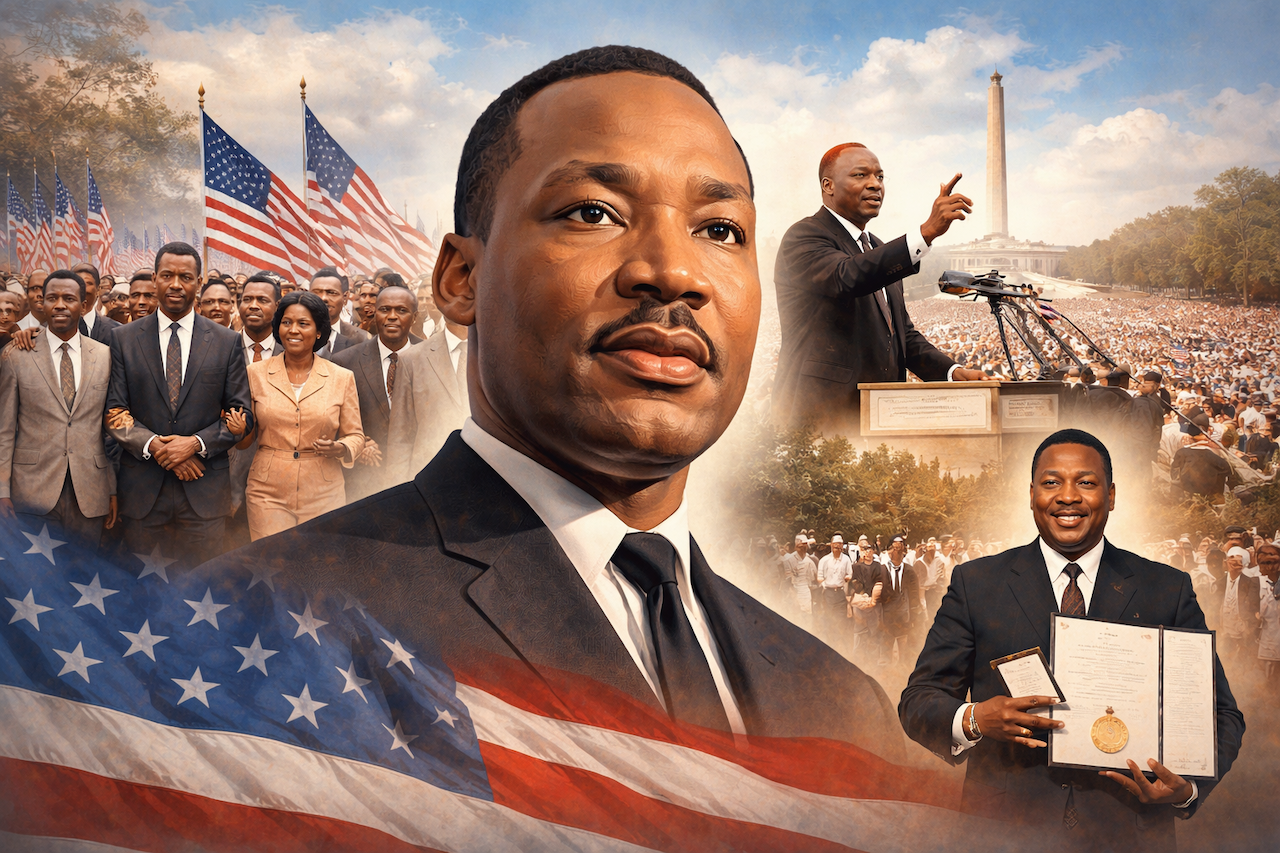
King’s most iconic moment came in 1963 during the March on Washington for Jobs and Freedom, where he delivered his historic “I Have a Dream” speech at the Lincoln Memorial. Speaking to more than 250,000 people, he articulated a vision of an America where individuals would be judged by their character rather than the color of their skin. The speech remains one of the most significant orations in U.S. history and a defining expression of the nation’s democratic ideals.
His advocacy played a pivotal role in the passage of landmark legislation, including the Civil Rights Act of 1964 and the Voting Rights Act of 1965. That same year, King was awarded the Nobel Peace Prize, becoming the youngest recipient at the time, in recognition of his commitment to nonviolent resistance and social justice.
Martin Luther King Jr. was assassinated on April 4, 1968, in Memphis, Tennessee, but his work did not end with his life. In 1983, President Ronald Reagan signed legislation establishing Martin Luther King Jr. Day as a federal holiday, first observed in 1986. Celebrated on the third Monday of January, the holiday honors King’s birthday and his enduring impact on American society.
MLK Day is more than a day of remembrance—it is a call to action. It encourages reflection on the ongoing pursuit of equality and justice and inspires service, civic engagement, and dialogue. Often referred to as a “Day On, Not a Day Off,” it invites people to honor King’s legacy by contributing to their communities and continuing the work he began.
Through his words, actions, and moral leadership, Martin Luther King Jr. helped move the United States closer to its founding ideals. MLK Day serves as a reminder of both the progress achieved and the responsibility to carry forward the principles of fairness, dignity, and peace for future generations.