

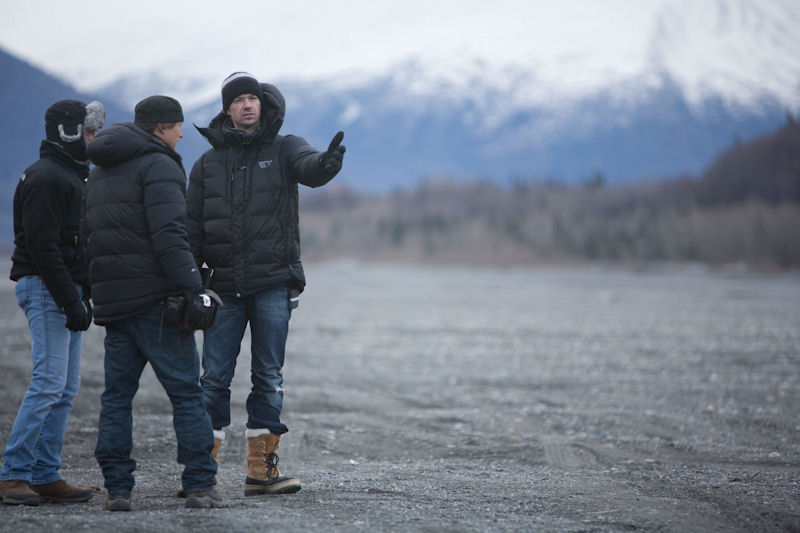
 With only one IMDB credit to his name, New Zealand born writer/director Scott Walker will be given his big Hollywood break with the upcoming release of “The Frozen Ground.” A stellar cast, reliable producing crew, and automatic distribution deal with Lionsgate, make Walker’s real life crime drama a dream come true for any filmmaker, let alone a freshman director. The former advertising mogul turned film auteur recently sat down with me to discuss Nicolas Cage, Alaska, and what it was like quitting his cushy job as an ad man only to start making movies.
This is the first time I’ve seen Alaska in a movie since, I don’t know, Insomnia in 2002? How was shooting a movie in Alaska?
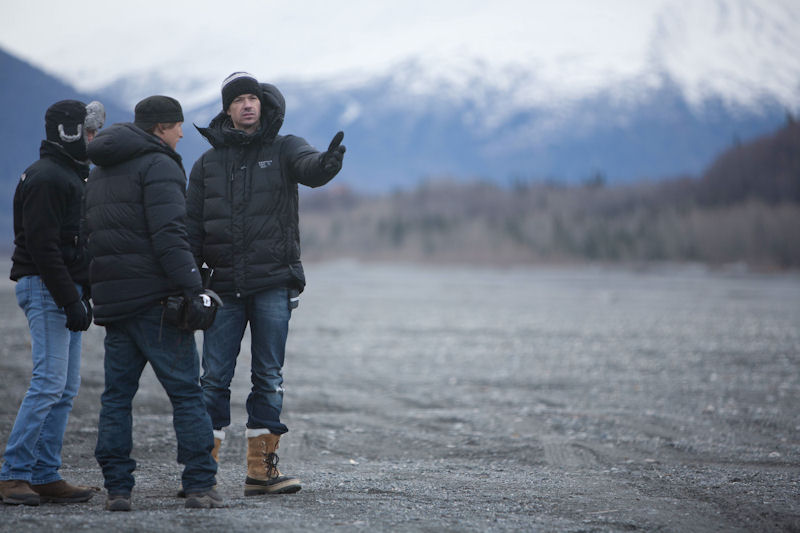
It was amazing. It was such an incredible place. In fact it reminded me of New Zealand where I grew up. Alaska is like a much bigger version of New Zealand come to think of it. We don’t have bears and moose and bald eagles flying around everywhere, but it’s a similar culture. They have a great, sort of can-do attitude.
There are a lot of challenges being right up there in the cold, but there are just these vast, epic, amazing landscapes as well. Literally, the mountains are like a wall that makes the city like a citadel, which is what I wanted to try and reinforce in my film. When you look down these long roads, you’re always reminded of the Chugach Mountains, which is where Hansen would take his victims in the movie.
Did you ever have a backup shooting location in mind?
Never; it was a deal breaker for me. I had a lot of conversations with different people who wanted to shoot the film in other places—even in British Columbia—and I was like, ‘No.’
When I first went to Alaska, I met with the government people there and said, ‘I’m thinking of doing a film about this murder case,’ just to see whether they would be supportive or not, and they said, ‘We’re supportive, and you have to do this film in Alaska.’ I said, ‘That’s what I feel,’ and they said, ‘This is part of our history. It’s the largest police, law enforcement case that’s ever happened up here. For better or worse, it’s a story about Alaska and we’d love for it to be filmed up here.’ And I said, ‘That’s great, because I want to film in as many of the real locations as I can.’
How was the general public’s opinion of having you guys around town, shooting a story that matters so much to their community?
Amazing. Everyone has a story. I can’t remember how many times someone told me, ‘I went to school with Hansen’s kids,’ or ‘I grew up next-door-to-him,’ or ‘I went to his bakery,’ or, ‘he was in the same church as me.’ Everyone knows everyone. It’s one of those communities, and so when that happened, it left a big scar on the community. Suddenly people lost their trust. There was an innocence to a lot of American cities in that era that ultimately got lost. This was one such city that got completely destroyed. It was like, ‘Wow. That guy who lived down the street from us did all of those horrible things for 13 years? It had a huge impact on the community, so it was incredible having all of that input and involvement.
In writing a script that spans 12 years, you had to leave out some pretty important details, obviously. What were some of the events that you decided to skim over?
What I decided was this story is really a drama about the relationship between Cindy Paulson and Jack Halcombe, who is based on Glenn Flothe, the real Alaskan sergeant in the case. I then realized that the movie couldn’t start before June 13, 1983, which is when Cindy escaped Hansen, was grilled by the police, told she was a liar, and put back on the streets.
Glenn wasn’t involved in the case until about two months later, in September, when Paula Goulding’s body was found, so that really gave me my sort of start, and obviously Hansen had to erupt and be found guilty at the end. That kind of gave me the perimeters of what I wanted to do, and there were twelve and three-quarter years of information and cases that need to be brought into that timeframe somehow.
Then I kind of wanted to do that through Glenn’s journey in the police case, as he started putting it together at the same time as him realizing more and more that Cindy is the key and that she’s the only one who survived that would come forward. It’s about that sort of relationship, and it’s also complicated because from that perspective, they knew Hansen was the suspect very, very early on.
As soon as Halcombe meets Cindy, in the film, and she says, “This is the guy,’ I mean, there’s not much to hide anymore. You can’t go for another 60-70 minutes pretending you don’t know who the killer is. It’s over, so that then set the tone for the film. This is not a whodunit, this is a ‘hedidit.’
A get-the-guy kind of film.
A ‘How the hell do you get the guy?’ And in those days, it was all about the overwhelming mountain of evidence required to convict. There’s no DNA, there’s no blood, there’s no fiber analysis anywhere like there is today. That became the challenge. I’d done all the enormous amounts of research, and had like, 15-foot posters of 13-years of everything that had happened, and another 15-foot poster of every single day of the case from the police notebooks. Then you’re forced to go, ‘Now I’ve got to put this into less than two hours. What really is compelling to me, and what do I really want to explore?’
I’d looked at “Zodiac” and “Gone”. I just didn’t want to tell another movie like that. And so I thought I’d start with the point where you find Cindy—she’s the heart of the film—and then capture the beginning of the case. That was pretty much the way I decided to tell it. It sounds easy now, but it took me a year to figure that out.
You kind of had to become an amateur detective to put everything together it sounds like.
That’s what Glen said to me. When I told him what I was doing, he then sent me a photo and said, ‘Here was my room. You’re doing exactly what I did.’ And he actually said, ‘I think that’s great; you’re obviously doing it the right way.’ Not because he did it the right way, but his method worked out, and he said, ‘You’re following the same intuition that I followed, so something’s going on.’
You also had a really great cast in this, too, and as a first-time director, it must have been awesome to have had the cast that you ended up with. What was it like trying to kind of navigate these people who have been in the business so long? Did you take tips from them?
They’re all amazing and very, very different. And you know somepeople told me, ‘Nic [Cage] and John [Cusack] are powerful forces—they’re just going to take you where they want to go.’
Drag you around.
Yeah. And whether I actually believed it or not, you cannot help but have that in your subconscious. I felt I knew exactly what I wanted to do and I knew if I didn’t, I’d lose control of my cast. So I had to be more than prepared, even more so because of the shooting schedule. 225 scenes in 26 days is a pretty crazy schedule, so we were doing 10 scenes a day some days. And scenes would be very, very different. I’d have scenes with Nick, and then another scene with John, and then another scene with Vanessa [Hudgens], and then it’d be Nick and Vanessa—all in one day. Very intense scenes, so I think that was it. It was just by being really prepared and knowing exactly what I’d wanted and then, ‘Okay,’ (claps hands), ‘Let’s go,’ and kind of setting the pace, because I had to out of necessity and not worry about, ‘Wow, it’s Nicolas Cage,’ but go, ‘Okay, great. He’s amazing. Now put that to one side and so it’s John; it’s Vanessa’ It’s like, ‘This is what we are going to do,’ and we just got on and did it.
This movie was supposed to come out last December, right?
I finished my cut in March of last year. Then it got screened for Lionsgate, and they said ‘Yes, it’s theatrical,’ which was terrific. And then Lionsgate bought Summit, and the whole merger happened and literally for five or six months we sat around going, ‘We need to finish this film—who are we dealing with?’ It was in September or October of last year that I went back in and got the notes. We hadn’t done sound mix, color, or anything. We redid the score—because then I had to recut the film with their notes—though not massively. Then it was like, ‘Now we’ve missed November when this would have be great for this to come out. I started looking and asked, ‘Well, the next window is really maybe March, April?’ and Lionsgate looked at what else they had going on, and were like, ‘That’s not a viable window for us, but August is.’
So then I guess from genesis to this August when it releases, how long have you been working on this project?
I quit my job to do this.
In advertising, right?
Yeah. That was in 2005, so I’ve been working on the film for 8 years. I started my research at the end of 2008, but really in the beginning of 2009. I met Glenn Flothe in February 2009, so that was 3 and a half years ago. It would be like, ‘Go, go, go, go, go! Make the film. No, wait.’ It’s the hurry up and wait that’s the hardest. Last year was like, ‘What are we doing? When’s it coming out? Nobody knows. Who are we dealing with? Who’s going to shepherd it now at Lionsgate? Who’s really in control?’ and suddenly it’s like, ‘Okay, here’s the guy; this is what we’re going to do, now you’ve got to finish it—go.’ Then when you go to finish it, then it’s like ‘Now we wait.’ I’m sure this is a normal process, but—
Normal? I mean, not too many people just quit their job.
I know (laughs).
How were the emotions that went along with that? What was the toughest part about deciding to suddenly become a filmmaker?
I didn’t really think about it. Once I had the thought, I was like, ‘If I don’t do this and if I waver…’ I had a really successful agency in London where we did the global brand vision behind the global launch of Xbox.
That was our founding client, which was terrific and we were doubling profits year after year, but one day I told my accountant, ‘I’m going to shut it down,’ andhe was like, ‘You’re crazy.’ I said, ‘No I’m not,’ and he told me, ‘You’re really profitable and you’re making lots of money’ and I said, ‘Well, if I don’t do this now, I don’t think I ever will, and I’ll always regret it, and this is something I’m really passionate about and I’m going to try it.’ And he was like, ‘All right.’
He’s still my accountant today.
He still stuck with you?
Yeah, and he’s a good friend. It was funny, because I was doing a mythic story structure course, and that for me was the course that made me see structure in a way that I understood it.
Like ‘The Hero’s Journey’ you mean?
Yes. I did McKee and Syd Field screenwriting courses before that. And I understood them, but they didn’t really grab me; I don’t know. It was kind of like when I was in that Hero’s Journey course, I was like, ‘Wow, I feel like I’m seeing through the Matrix.”
I was actually in the class with a very senior client of mine back then, who was doing it from a brand perspective, and he looked at me and said, ‘What on earth are you doing here?’ and I said, “because I really like films,’ and he said, ‘But you don’t do films….’
I told him I was going to become a filmmaker, and he said, ‘Wow what are you going to do, and I said, ‘I’m going to go home and tell my wife and tell my business partner. We’re going to shut the agency down and go and do this.’ it’s been an incredible journey and it’s been a lot of ups and downs. I spent a lot of time asking myself ‘Am I mad? I’m sure all of my family thinks I am completely mad.’
Now they’re like, ‘Yes, we believed in you this whole time!’ All my friends think I’m crazy, but it’s been incredible.
It’s been an amazing journey and it’s only now just beginning.
Scott Walker’s “The Frozen Ground” opens in theaters and Video On Demand on August 23, 2013.
By David Morris